
Research
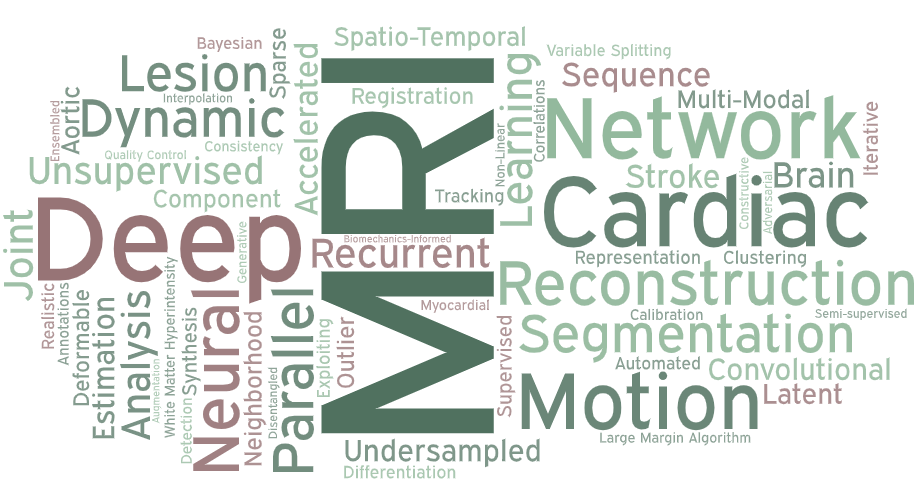
We are working on several projects in machine learning, high-performance medical image analysis and computing. This is the word cloud generated from the titles of our papers, showing keywords such as MRI, deep neural network, reconstruction, segmentation, motion etc.
Projects
- Multimodal Representation Learning in Biological Data
The goal of this project is to find the synergy between artificial intelligence (AI) and the large-scale multimodal high-content screening data, through creating innovative multimodal representation learning techniques that are beyond supervised learning, for realizing more efficient and accurate inference of biological relationships amongst genetic and chemical perturbations. The outcome of the research will potentially have a widespread impact on the future of AI-enabled drug discovery and ultimately bring significant benefits to the pharmacy industry. - TrustMRI: Trustworthy and Robust Magnetic Resonance Image Reconstruction
The TrustMRI project aims to tackle the critical and growing problem of artificial intelligence (AI) trustworthiness for AI-enabled magnetic resonance image (MRI) reconstruction from accelerated acquisitions. MRI is the leading diagnostic modality for a wide range of exams, but unfortunately the physics of its data acquisition process makes it inherently slow. Recently, AI techniques have opened the possibility to accelerate this considerably. However, the lack of consideration of their trustworthiness and failure management on unseen cases limits their translational potential in clinical practice. The objective of the project is to enable the advancement towards trustworthy and robust AI-based MRI reconstruction, through equipping them with the ability to model uncertainty and handle cases outside distribution. The research will develop advanced deep learning (DL) methods that can quantify, evaluate, and leverage predictive uncertainty for reliable and robust MRI reconstruction. - Machine Learning for Motion-Robust fMRI
The project aims to develop novel machine learning models for functional MRI (fMRI) motion correction, incorporating infant motion as a target domain. fMRI is a leading non-invasive modality to measure brain activity and connectivity and is used throughout the lifespan. However, subject motion represents a formidable challenge for fMRI and thus limits its clinical applications. This project will aim to enable the advancement towards motion-robust and efficient fMRI, through exploring advanced machine learning techniques for fMRI motion correction. - Deep Generative Models for Inverse Problem of Accelerated MR Imaging
- Multimodal Representation Learning in Biomedical Data
- Contrast-Agnostic Deep Learning-Based Image Registration